
Boris Johnson says facilitating the reunification of the Parthenon Marbles would be a disaster
Boris Johnson says facilitating the reunification of the Parthenon Marbles would be a disaster

Johnson rolls out the floodgates argument like a frayed carpet once more, moths and all. This is despite it being one of the easiest parts of the retentionist cause to refute, especially in light of recent, successful repatriations from collections throughout the global north. Were the floodgates to open, and the museum to lose one item an hour, day and night, bank holidays and all, it would take over 650 years to empty the museum.
– Stuart O'Hara, BCRPM member
Boris Johnson was interviewed in Greece and at 14:20 into the video (link below), he explains why the Parthenon Marbles cannot ever go back: “it would be a disaster” for the British Museum and London’s most visited museum, says Boris.
The British Museum is a central London Museum that is free for all visitors.
Stuart O’Hara, member of the British Committee for the Reunification of the Parthenon Marbles (BCRPM) reflects below on what Mr Johnson’s current response to the reunification of the Parthenon Marbles means to the on-going campaign.
There’s a short YouTube interview doing the rounds right now. It’s between Boris Johnson and journalist Vassilis Kostoulas, and is brokered by the Economist’s SE European arm. Kostoulas saves his questions about the Parthenon Marbles til last – Johnson must have known this was coming – and asks the former PM how Mitsotakis’ question was shaped at their last meeting.
“I fully understand why the Prime Minister of Greece would raise this issue. I had to tell him… this is a difficult issue for us too”. It doesn’t come across in print, but to hear Johnson say it, I suddenly became aware (as many have before) of something essential to his public life: to this man, politics and diplomacy are an extension of the school debating society, an environment where your argument needn’t reflect your true feelings. Your job is to argue the side you’ve been assigned, to win, and dispense with any fervour you may have displayed at the podium upon leaving the room.
Johnson rolls out the floodgates argument like a frayed carpet once more, moths and all. This is despite it being one of the easiest parts of the retentionist cause to refute, especially in light of recent, successful repatriations from collections throughout the global north. “There is a problem. [When I was Mayor of London] we did a tourism campaign, and the British Museum is the most-visited attraction in the most-visited city in the world.” That may well be the case, but we already know that the majority of the Museum’s 5.8 million visitors a year don’t visit Room 18 (which will be closed for an indefinite period over the next few years, as the west wing is redeveloped to a design by Lina Ghotmeh).
Once more, for those at the back: the Parthenon Marbles are an holistic case, uniquely rooted in architecture and cultural identity. The broad dynamic of cultural traffic between two colonial powers at the expense of an occupied ethnic group with a connection to the booty is not unique, but we have considered the risk of emptying the world’s museums throughout our campaign and, frankly, it would take more than simply lack of resistance on curators’ parts to make that happen. They would have to actively disseminate the collection – and not in the (alleged) fashion of former curator Peter Higgs.
As pointed out, the British Museum’s collection numbers around 8 million items. The cataloguing system is haphazard. For example, one trunk of diverse objects of unknown provenance may be listed as a single item (it should be acknowledged that the Museum is working on this, with Director Nicholas Cullinan pledging to digitise the 40% of the collection currently not online within the next five years).
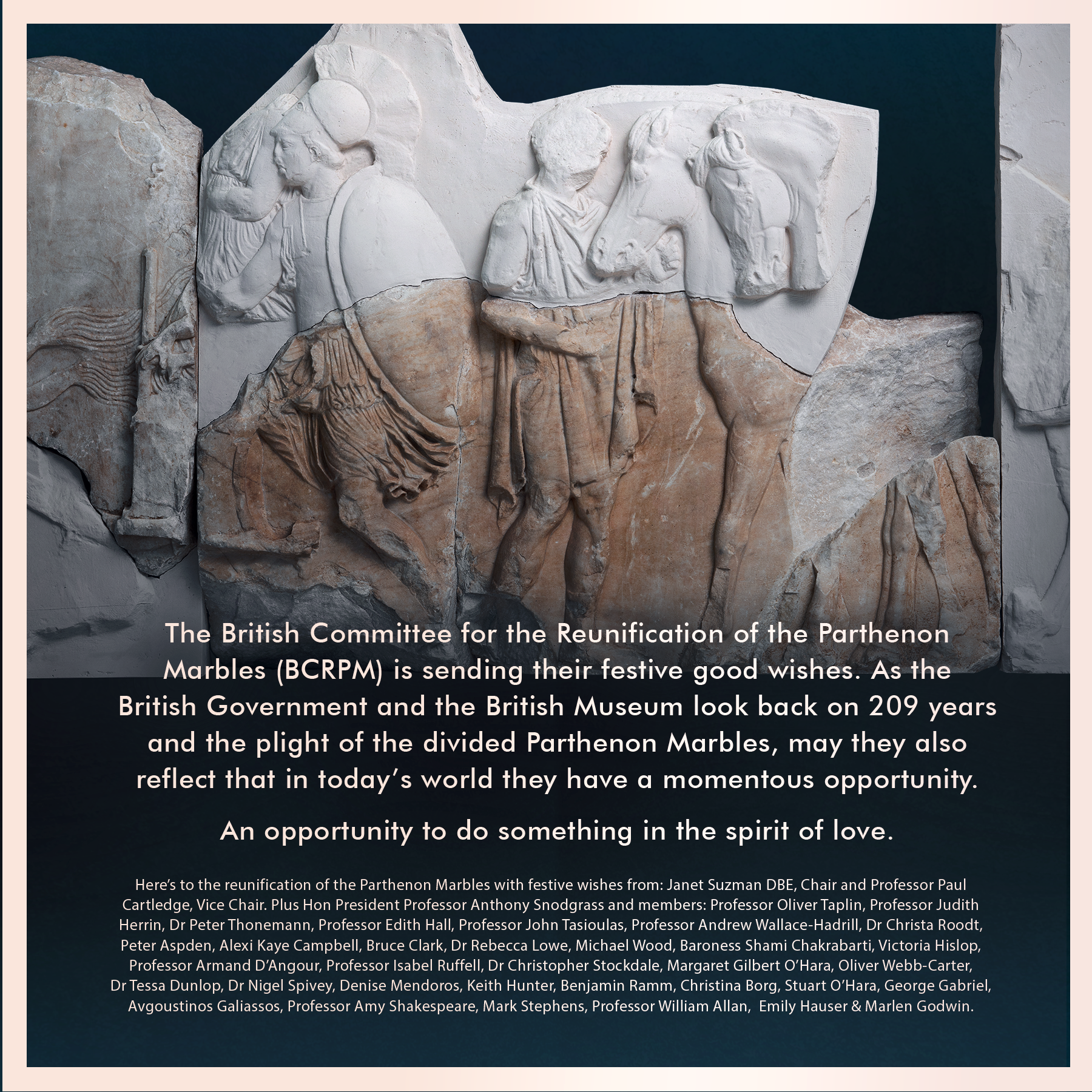
We campaign for the return of 21 figures from the pediments, 15 metopes, and 75m of the frieze, consisting of 56 blocks of marble. Were the floodgates to open, and the museum to lose one item an hour, day and night, bank holidays and all, it would take over 650 years to empty the museum.
Back to Johnson. He knows any Greek politician meeting their British counterpart is going to ask about the Marbles, and Johnson treats it as a classical move (no pun intended) to be expected, dealt with, and forgotten.
Towards the end of the interview he affirms the continued existence of the Conservative Party as “the oldest and most successful political party in Europe – even more than PASOK!” That jab tells us this is just a game to him, like the rest of life. Supporting retention, pretending you’re still at school on the cusp of retirement age, clinging to a political party in its mortal hour… perhaps the former PM is the one who should be on display in the British Museum.
Stuart O’Hara, BCRPM member