
New poll conducted by JL Partners on the reunification of the Parthenon Marbles
New poll conducted by JL Partners on the reunification of the Parthenon Marbles
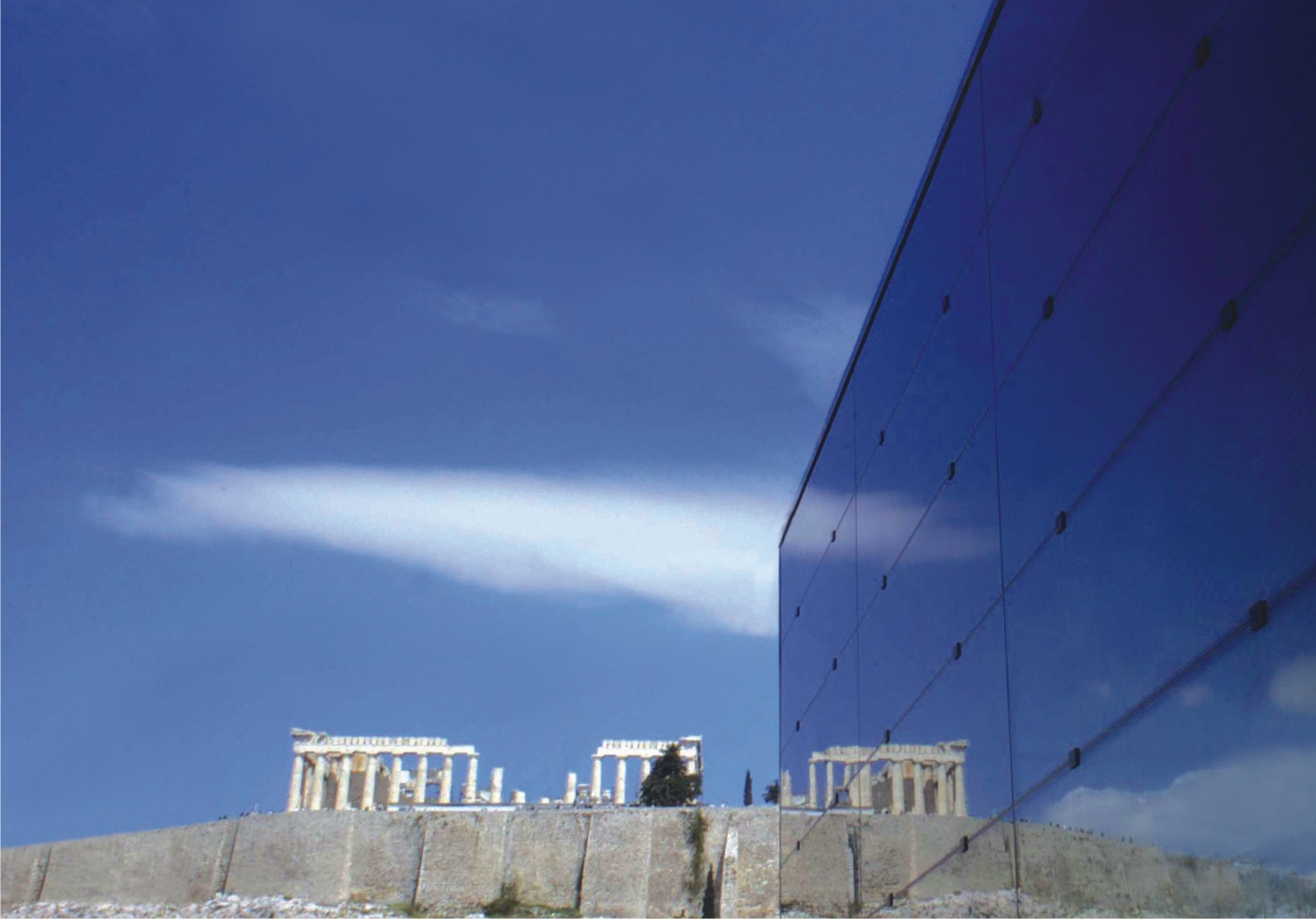
When those surveyed were shown photographs from the Duveen Gallery and the Acropolis Museum, 55% chose the Acropolis Museum as the best place for exhibiting Greek antiquities.
– Nikolas Zois, Kathimerini
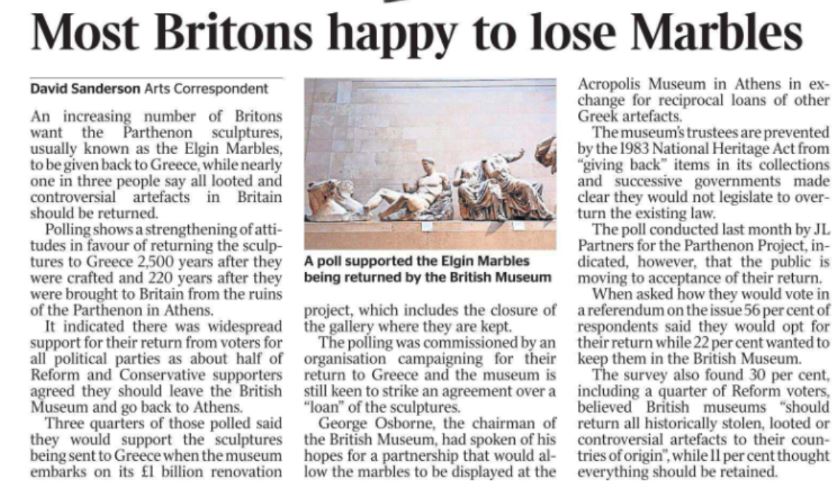
“A recent poll shows that public support is growing for the artefacts to be returned to Greece, from where they were taken in the 19th century. ” Wrote David Sanderson, Arts Correspondent for The Times on 09 September 2025.
The poll conducted by JL Partners asked how Britons would vote in a referendum on the issue of the Parthenon Marbles and 56 per cent of respondents said they would opt for their return with just 22 per cent voting to keep them divided between the British Museum and the Acropolis Museum.
The Times article on 09 September 2025:
Polls over many decades have always been in favour of the return especially when respondents were made aware of how these sculptures came to be divided mainly between Greece and the UK.
Yannis Andritsopoulos in Ta Nea also wrote: ‘British voters of all parties are in favour of the return of the Parthenon Sculptures to Greece and without any prerequisites, according to the largest poll.
Most Britons say they will vote for the Greek request if their government holds a referendum on the issue, believe that the law should be changed to allow the British Museum to decide on the future of Phidias’ masterpieces (currently they are only allowed to lend these), and assert that the Sculptures are part of the Greek identity and not the British one.’
Nikolas Zois wrote in Kathimerini on 12 September: “47% of Conservative voters who said they were in favour of the return matter, even if the Labour government, whose electoral base supports the demand by 62%, changes hands, the mood may not turn dramatically negative.
The main thing is that in this latest poll, the majority of Britons, 54% say “yes” to the reunification of the Sculptures. Only 29% want them to remain in London. The scenario of returning the Marbles to Greece for as long as the Duveen Gallery that houses them is closed, due to the upcoming renovation of the British Museum, was agreed by 74%, while in the event of a British referendum on the whole issue, 56% would vote to return them to Athens, compared to 22% who would like them to remain. And when those surveyed were shown photographs from the Duveen Gallery and the Acropolis Museum, 55% chose the Acropolis Museum as the best place for exhibiting Greek antiquities.
An interesting finding is that 72% agree that the Sculptures are best understood as a single artistic ensemble with the Parthenon. Even so, given previous polls on this matter, one wonders: can British public opinion ultimately exert some kind of pressure on the Museum and the British government? Or do such surveys constitute a positive record, keeping the issue current, but without changing the parameters on the basis of which decisions will ultimately be made?”
Nikolas asked these questions to Irini Stamatoudi, a lawyer, professor at the Law School of the University of Nicosia and Professor Paul Cartledge, Emeritus Professor of Greek Culture at the University of Cambridge and Vice-Chairman of the British Committee for the Reunification of the Parthenon Marbles.
Irini Stamatoudi is quoted saying that this poll “was helpful (and especially for the British government itself to see) that this instrumentalization does not express public sentiment. It goes against the people’s perception of morality and law. In essence, it facilitates the continuation of negotiations that we all hope will have a happy ending.”
Professor Paul Cartledge reflected: “This recent UK Marbles poll found 56% in favour of reunification in a possible referendum; in fact, almost one in three respondents said they wanted all looted or controversial works of art in Britain to be returned to their countries of origin.
Such findings now consistently show a clear majority in favour of reunification and certainly put some pressure, not a great deal, on the British Museum’s trustees, particularly those who have already clearly taken a position for or against reunification. However, they are not enough on their own to sway the stance of the institution’s main negotiator, the chairman of the trustees, George Osborne.
As for the British (Labour) government, the parameters that usually determine its stance are other than opinion polls on the Sculptures, although this is an issue of major international cultural importance and which is ultimately political, as its fate is determined by laws enacted by parliament. Today and for the foreseeable future, the British government has to deal with such a multitude of other pressing issues, both domestically (e.g. immigration) and internationally (such as the war in Ukraine) and shows no inclination to give priority to the issue of the Sculptures.
For the British Museum, by contrast, the issue is certainly at the top of the trustees’ agenda, especially now, in view of the planned, extremely costly renovation of the entire West Wing of the institution, which also includes the Duveen Gallery that currently house the Parthenon Marbles.”