
Parthenon Marbles campaigners call on British Museum and UK Government to stop referring to ‘firman’ after Türkiye confirms no such permission exists
Parthenon Marbles campaigners call on British Museum and UK Government to stop referring to ‘firman’ after Türkiye confirms no such permission exists

The British Committee for the Reunification of the Parthenon Marbles (BCRPM) has called on the British Museum and UK Government to remove references to an Ottoman “firman” from public statements and visitor information, after Türkiye yet again confirmed at UNESCO’s ICPRCP that no such official document authorising Lord Elgin’s removal of the Sculptures exists.
At the 25th session of UNESCO’s Intergovernmental Committee for Promoting the Return of Cultural Property to its Countries of Origin or its Restitution in Case of Illicit Appropriation (ICPRCP), held in Paris 20-22 May 2026, Türkiye’s representative, Zeynep Boz, respectfully asked the UK delegation to stop referring to such permission.
Her intervention follows her statement at the previous UNESCO session when she made clear that no firman authorising the removal of the Parthenon Sculptures had ever been found in the Ottoman archives. Greece’s position remains as it always has, that the export to Britain of the figures from the Parthenon by Lord Elgin was unauthorised.
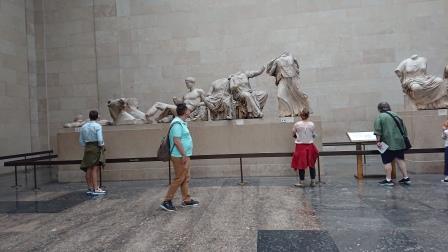
BCRPM said the latest intervention should prompt the British Museum to review the wording used in its visitor information for the Duveen Gallery, where the Sculptures are displayed. The public has every right to be given to understand that the ownership of the Parthenon Marbles remains contentious.
Last year, representatives of the Committee met with British Museum Director Nicholas Cullinan, Dr Thomas Harrison, Keeper of Greece and Rome and Dr Rosie Weetch to discuss the Museum’s wording around the Parthenon Sculptures. The Committee asked the Museum to amend references to the alleged “firman” both in its literature, and on explanatory texts alongside exhibits.
At UNESCO, Greece’s case was presented by Professor Nikolaos Stampolidis, Director General of the Acropolis Museum, and Artemis Papathanassiou, Head of the Special Legal Service at Greece’s Ministry of Foreign Affairs. The case for the reunification of the Parthenon Sculptures was presented highlighting key historical dates from the time of the removal of the sculptures in the early 19th century to present day. Artemis Papathanassiou questioned the lack of will on the part of the UK government to progress the matter as outlined by the decision taken by UNESCO’s ICPRCP in 2021. The UK was represented by Ruth Hannant, Director General at Department for Digital, Culture, Media and Sport (DCMS) and Dr Rosie Weetch, Head of International and National Partnerships at the British Museum. There was nothing new in what was presented by the UK side.
Twenty countries spoke in support of Greece’s position, with no state speaking in support of the UK.
Dame Janet Suzman, Chair and Professor Paul Cartledge, Vice-Chair for the British Committee for the Reunification of the Parthenon Marbles (BCRPM) said:
“For decades, the so-called ‘firman’ has been used to suggest Lord Elgin had legitimate permission to remove the Parthenon Sculptures and that this also legitimised the purchase of the sculptures by the then British government from Lord Elgin in 1816. Türkiye has now made clear, not once but twice at UNESCO, that no such document exists in the Ottoman archives.
“The British Museum and UK Government must stop relying on language that gives visitors and the public a misleading impression. This is not a minor wording issue. It goes to the heart of the case for reunification.
“The Parthenon Sculptures are not isolated museum objects. They are integral parts of a monument of outstanding universal value. Their continued division prevents them from being understood as a whole.
“The surviving Parthenon Sculptures belong together in Athens, where they can be seen in their proper historical, cultural and architectural context, in sight of the Parthenon itself.”
The Committee will continue to press the British Museum to revise its public information and will issue updated visitor material to help ensure the full story is told.
The Parthenon Sculptures have been on UNESCO’s agenda since 1984. The British Committee believes their reunification remains one of the most important cultural heritage issues of our time.
ENDS
For more information contact Marlen Godwin on 01780 460145 or 07789533791, and email marlen@fcdcom.co.uk
Notes to editors:
1. Find the section of Thursday, 21 May 2026, ICPRCP presentations by both Greece and the UK, visit the link and fast forward to to 4:33:33
Item 7/Point 7 Return and Restitution Cases, the Parthenon Sculptures:
https://webcast.unesco.org/events/2026-05-25ICPRCP/
To listen to Zeynep Boz’s intervention, fast forward to: 5:37:21
2. Letter from DCMS to BCRPM received on 24 March 2026, from a member of the Ministerial Support Team, in response to email sent to Rt Hon Ian Murray MP on 02 March:
We note your reference to the decision taken at the 2021 UNESCO Intergovernmental Committee for Promoting the Return of Cultural Property (ICPRCP) that this matter is ‘firmly intergovernmental’. The government’s position is that the ICPRCP decision is factually incorrect, and we made that clear at the time. As mentioned above, the British Museum is independent of the government and its governing legislation explicitly gives responsibility over the collections to their trustees. The government views this as a matter for the British Museum’s trustees, not for a government-to-government negotiation.
3. In 2020 BCRPM’s Chair, Dame Janet Suzman wrote a pamphlet to reflect the one in the British Museum, it was entitled:
Tell The Story.
Just imagine a world culture museum where the whole story is told. It’s not just possible – it’s respectful. We urge the British Museum to provide the full story to visitors.
The simpler truth is that no original documentation granting Elgin legal permission to remove the sculptures has ever been found.
Elgin had a questionable document written in Italian referring vaguely to ’some pieces of stone’ which he claimed was issued from the Ottoman Sultanate but given the form and language is dubious to say the least.
4. In June 2026, a new flyer will be printed by BCRPM to raise points to counter those made in the British Museum’s current flyer on the Parthenon Sculpture.
5. Read Professor Paul Cartledge’s words written 02 February 2021, ‘For the Reunification of the Parthenon Marbles: An Immodest Plea‘. Professor Cartledge was one of the earliest members of BCRPM (1983) and has served as Vice-Chair of the Committee since 2016.
6. Read the Independent article published in The Independent by BCRPM member Victoria Hislop in 2023 and entitled:’ Why the Greek PM won the debate over the Elgin marbles‘
7. Listen to Mark Stephens CBE, consultant at Howard Kennedy and member of BCRPM on an episode of Kids Law Podcast with Alma-Constance and Lucinda on the question of, ‘Who owns history?’. Podcast was recorded in February this year.