
Latest Posts
Pericles and Paul Cartledge an interview with Ta Nea
Pericles and Paul Cartledge an interview with Ta Nea
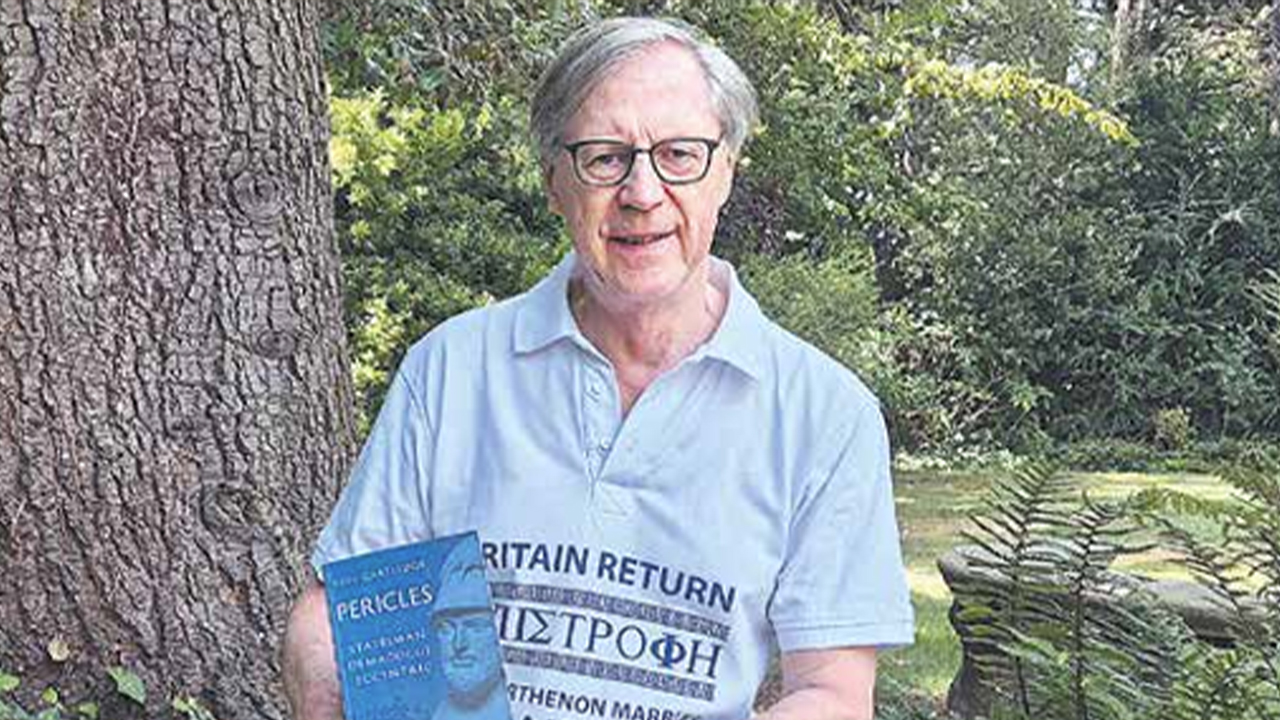
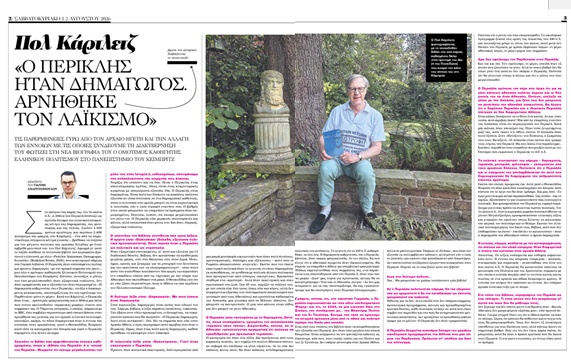
‘The man behind the myth: Paul Cartledge on the real Pericles’ is the title of the article in Ta Nea, an in-depth interview by Yannis Andritsopoulos with Professor Paul Cartledge.
The image of Pericles as the all-powerful architect of Athens’s Golden Age has endured for more than two millennia. But according to one of the world’s foremost authorities on ancient Greece, that familiar picture is more complicated than many assume.
In an interview with the Greek daily newspaper Ta Nea, marking the publication today of his new book, Pericles: Statesman, Demagogue, Eccentric, Cambridge classicist Paul Cartledge argues that the Athenian leader’s influence has often been exaggerated and that even the notion of an “Age of Pericles” deserves closer scrutiny.
“What people seem to misunderstand is the nature of democratic politics in a direct democracy,” Cartledge says. Unlike modern leaders, Pericles had no political party behind him and wielded nothing like unchecked authority. “Pericles’ power was relatively restricted. He was very much on his own,” Cartledge says. “He was very, very vulnerable constantly.”
That vulnerability, he argues, is one reason why comparisons between Pericles and modern authoritarian rulers are fundamentally misplaced. Cartledge dismisses attempts to liken him to figures such as Vladimir Putin or Xi Jinping as “wildly anachronistic”, stressing that classical Athens had neither a standing police force nor the machinery of state repression associated with modern dictatorships.
Far from ruling Athens, Cartledge says, Pericles himself was subject to the will of the democracy, which eventually removed him from office and fined him during the Peloponnesian War. “It was the democracy that ruled Pericles and not the other way around,” he stresses.
The book also revisits one of history’s most celebrated political reputations. Cartledge argues that Pericles fully deserves to be remembered as an exceptional statesman, having been elected general year after year at the height of his career, yet insists the second word of his subtitle, ‘demagogue’, should not be understood in its modern pejorative sense. In ancient Athens, he explains, a demagogue was literally a leader of the people, and Pericles was “a very good demagogue and not a bad one”.
Nor does Cartledge shy away from Pericles’ contradictions. Although born into one of Athens’ wealthiest aristocratic families, Pericles was, politically, ‘consistently, as I’ve put it, on the left’, Cartledge says, describing him as both a committed democrat and an unapologetic imperialist.
He also argues that Athens’ democratic ideals coexisted with an empire that demanded tribute from its allies in return for protection against Persia – “a bit like the mafia”, where the choice was to “pay up” or face the consequences. “I do believe that there is a case to argue against Pericles for defending the empire without restraint,” he says.
Among the book’s most striking reassessments is its treatment of the Parthenon. Although Pericles has long been credited as the driving force behind the building programme that transformed Athens, Cartledge believes his role has been overstated. The monumental construction programme, he argues, would probably have continued even without him, although he acknowledges that Pericles was one of its most influential advocates. Asked whether we owe the Parthenon to Pericles, his answer is characteristically nuanced: “Yes – and no.”
The private life of Athens’ most famous statesman also receives fresh attention. Cartledge argues that Aspasia, Pericles’ lifelong partner, has too often been reduced to the label of “mistress”, despite occupying the centre of one of the most remarkable intellectual circles of classical Athens. At the same time, he points to the irony that Pericles’ own citizenship law prevented him from marrying the foreign-born woman with whom he chose to spend the rest of his life.
Cartledge, Emeritus A.G. Leventis Professor of Greek Culture at the University of Cambridge and one of Britain’s most distinguished classical historians, has written or edited 32 books on ancient Greece. Described by the BBC as having done more than anyone over the past decades to advance public understanding of ancient Greek civilisation, he has devoted much of his academic career to explaining why the ancient world still matters today.
His latest work offers a more complex portrait of the man who shaped classical Athens: an extraordinary politician, a brilliant public speaker, a flawed imperialist, an unconventional private citizen and, Cartledge suggests, an enduring enigma whose life continues to provoke debate some 2,500 years later.
To read the full interview in English follow the link here.