
An event held in London with a panel discussion to rethink a UK-Greece cultural partnership as the British Museum prepares to reimagine its Western Range Galleries
An event held in London with a panel discussion to rethink a UK-Greece cultural partnership as the British Museum prepares to reimagine its Western Range Galleries
One might very well counter that the case for retention is tied up with British nationalism, but I was usefully reminded of the language BCRPM adopted in the early 2000s: that nationalism is a political concept, and culture an ethnic one, as per UNESCO’s pledge that ethnic groups have the right to enjoy the fruits of their culture.
– Stuart O'Hara, BCRPM
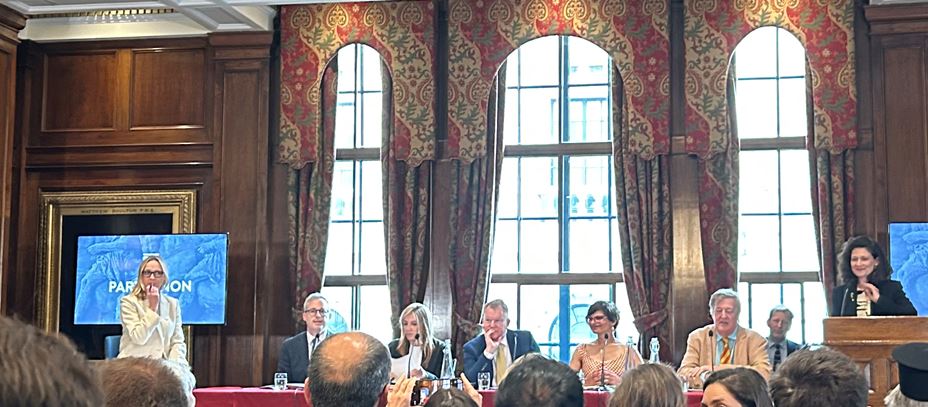
Rethinking a United Kingdom-Greece cultural partnership within the British Museum’s “reimagination”: What next for the Parthenon Sculptures?” An event hosted by the Parthenon Project, the newest campaign for the reunification of the Parthenon Marbles held at One Great George Street, London SW1P 3AA on the evening of Wednesday 11 June 2025.
A reference to Jacob Rees-Mogg as the Rt Hon Member for the Eighteenth Century was made and I was reminded of their bon mot during last night’s Parthenon Project debate, when Lord Sumption placed himself firmly alongside British Museum directors of yore in the Nineteenth. To be clear: he wasn’t on the panel, and though his contribution came during the Q&A, it was more of a statement.
This event on Wednesday 11 June organised by the Parthenon Project was nominally a panel discussion, but the returners on the panel, convened by Lord Vaizey and chaired by the BBC’s Katie Razzall, outnumbered the retainer 4 to 1.
Stephen Parkinson faced David Frost and Thangam Debbonaire (authors of that morning’s Times and Ta Nea editorials), Stephen Fry spoke about the history, and Mareva Grabowski-Mitsotakis (attended “not as [her] husband’s wife, but as citizen of the cultural sector”) spoke with passion.
Image ©Stuart O’Hara, BCRPM
This was less about an outcome to the argument, so much as an assessment of where we are now – the state of negotiations, which in Lord Frost’s view could be more transparent – and, as Gonda van Steen from KCL’s Centre for Hellenic Studies asked, where we’re going. She looked to a future in which the location of the marbles wasn’t specified, but our forebears (the “very clever young people” she works with) will have judged us accordingly. This raises interesting points about the vocabulary of location rather than propriety around the Marbles, which to me seems a smart approach to their less contentious presence in Athens.
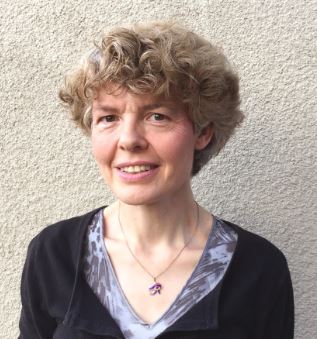
Gonda van Steen, Koraes Chair in the Centre for Hellenic Studies and Department of Classics at King’s College London
The last contribution to the Q&A was from BCRPM’s Vice-Chair Professor Paul Cartledge:
“I have it on good authority [a BM source] that there are certain donors who have said they will withdraw their funding in the event of returning objects. Suppose you encountered such a donor – how would you persuade them of ‘giving them back’?”
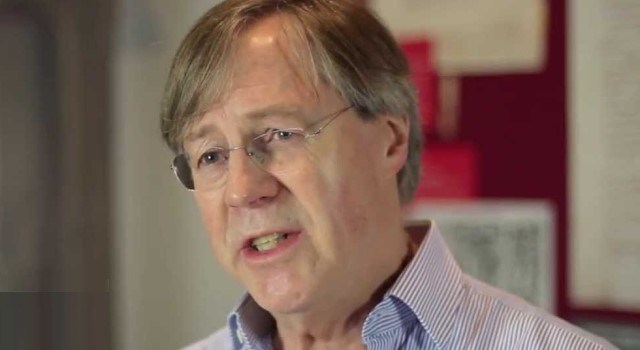
Professor Paul Cartlege, Vice-Chair BCRPM
Baroness Debbonaire’s response:
“Donors are important, but a donor who lays down such conditions is not in partnership with that organisation.”
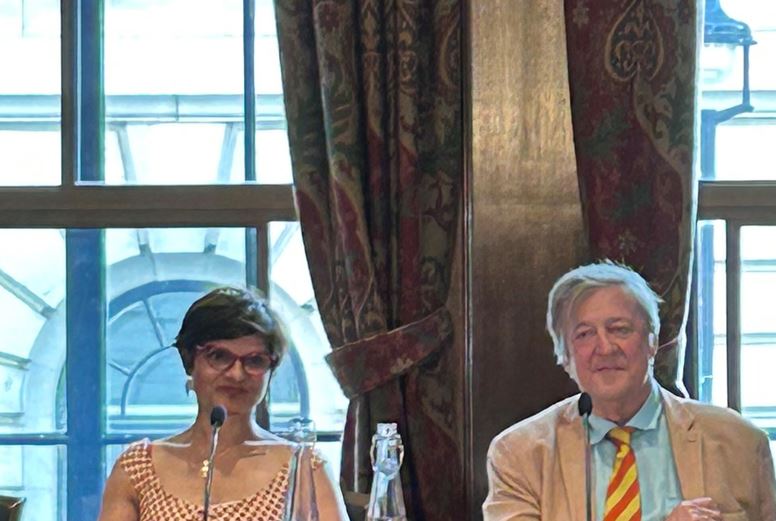
Baroness Thangam Debbonaire and Sir Stephen Fry
Image ©Stuart O’Hara, BCRPM
Indeed, such a donor would behave as if were a different century, and so back to Lord Sumption’s ‘question’. Lord Sumption made a spurious comment about the campaign for return being an instrument of “Greek ethnic nationalism”. One might very well counter that the case for retention is tied up with British nationalism, but I was usefully reminded of the language BCRPM adopted in the early 2000s: that nationalism is a political concept, and culture an ethnic one, as per UNESCO’s pledge that ethnic groups have the right to enjoy the fruits of their culture. I didn’t ask for the microphone – too many lawyers in the room!
Stuart O’Hara, BCRPM