
Latest Posts
Exhibition George Seferis: The Man, the Poet, the Diplomat, the Nobel Laureate
Exhibition George Seferis: The Man, the Poet, the Diplomat, the Nobel Laureate
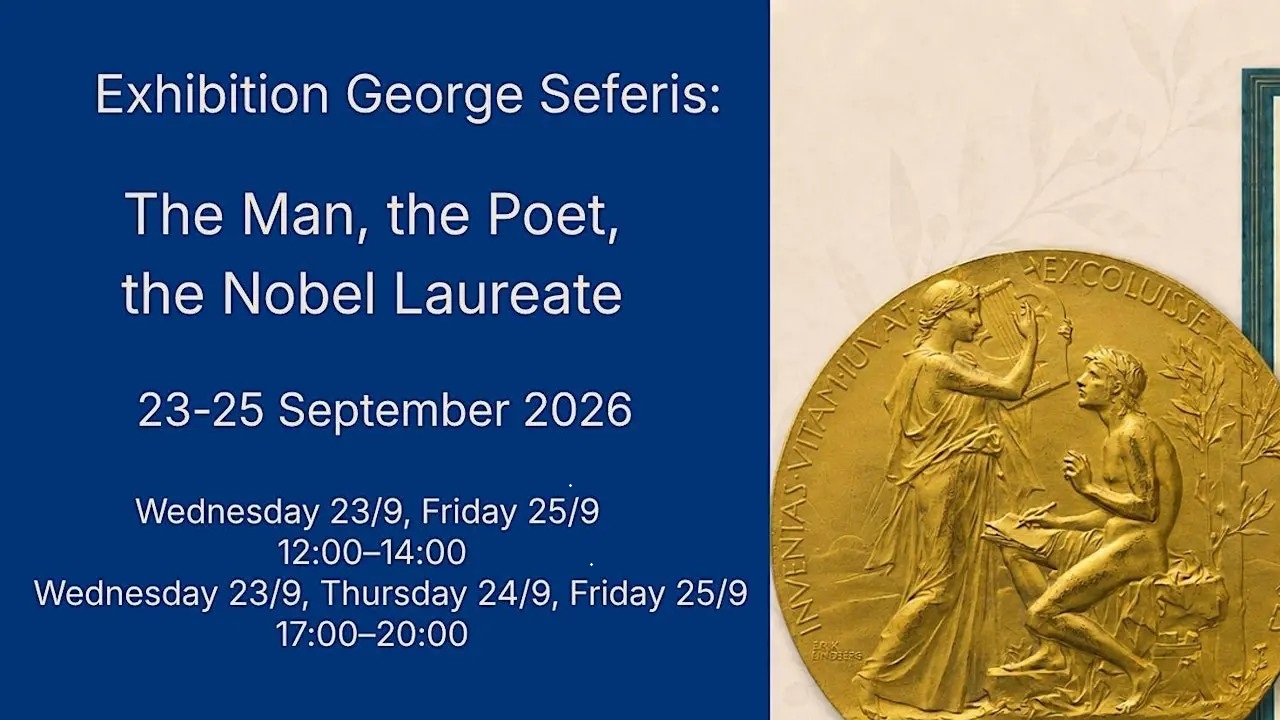
The Embassy of Greece in London is pleased to present George Seferis: The Man, the Poet, the Nobel Laureate, a special three-day exhibition dedicated to Seferis at the Hellenic Residence, offering visitors the unique opportunity to see, for the first time outside Greece, the Nobel Prize awarded to George Seferis.
At the heart of the exhibition are three important objects from the collection of the Benaki Museum:
- The Nobel Prize in Literature Diploma and Medal awarded to George Seferis on 10 December 1963.
- The manuscript of Seferis’ poem The Cistern, written in London in 1932
Opening Hours
Wednesday, 23 September 2026: 12:00–14:00 and 17:00–20:00
Thursday, 24 September 2026: 17:00–20:00
Friday, 25 September 2026: 12:00–14:00 and 17:00–20:00
Seferis in London
The display is presented at the Hellenic Residence, where Seferis lived and worked during his tenure as Ambassador of Greece to the United Kingdom from 1957 to 1962. It adds to the Embassy’s permanent exhibition, ‘George Seferis: The Man, the Poet, the Diplomat’, housed in the former Seferis Study at the Residence. The permanent exhibition explores the man behind the poet and diplomat, his years in London and his enduring relationship with Britain, while ‘George Seferis: The Man, the Poet, the Nobel Laureate’ brings visitors closer to the extraordinary culmination of his literary journey.
More than six decades after Seferis received the Nobel Prize in Literature, these historic objects will be displayed at the place where he spent some of his most significant years, offering visitors a rare encounter with a defining chapter in modern Greek literary history.
It was during his time as Ambassador of Greece to the United Kingdom that Seferis visited the sculptures in the British Museum. Observers note that his response to seeing them there was steeped in a melancholy sense of exile, viewing the displaced stones as being away from their proper home under the Attic light.
George Seferis in his critical essays such as A Greek — Makriyannis, championed the Greek War of Independence and leader General Makriyannis, who stopped revolutionary soldiers from selling ancient statues to European buyers.
General Makriyannis, who had no education and in his old age taught himself to read, had been able to preserve two ancient statues until the liberation. At that time he found that some soldiers were thinking of selling them.
Seferis quotes Makriyannis: “I took these soldiers aside and told them this: You must not give away these things, not even for ten thousand talers; you must not let them leave the country; it was for them we fought”.
And Seferis wrote: “You see it is not a great scholar, nor an archaeologist speaking. It is a shepherd’s son from Roumelia, his body covered with wounds “It was for them we fought”.
*Φωτ./Photo © Μουσείο Μπενάκη / Benaki Museum